Eielson AFB hosts Arctic Defender 24

Created 1 years 214 days ago
by Jim Araos

Views:

Over 500 personnel from the U.S., German, French, Spanish and Canadian air forces as well as the U.S. Marine Corps participated in Arctic Defender 24 at Eielson Air Force Base, July 8-18.
Spanish Air and Space Force soldiers from the 14th Wing load simulated weaponry on a Spanish Air Force Eurofighter Typhoon during Arctic Defender 24 at Eielson Air Force Base, Alaska, July 16, 2024. As part of a months-long deployment in the Indo-Pacific, known as Pacific Skies 24, AD24 is the first stop for the trinational Future Combat Air System of Germany, France and Spain. AD24 is a field training exercise for U.S. and international forces flown under simulated air combat conditions to bolster relationships, generate mission readiness and project power for a total force approach to maintain a free and open Indo-Pacific region. (U.S. Air Force photo by Airman 1st Class Jarrett Smith)
AD24 is a German Air Force-led field training exercise and part of the months-long deployment known as Pacific Skies. This deployment includes various exercise locations across the Indo-Pacific region, including the U.S., Japan, Australia, New Zealand, Malaysia and India.

“Pacific Skies is unique because it's the first time that the German air force will deploy all around the world,” said Brig. Gen. Frank Gräfe, German Air Force Pacific Skies commanding general. “To put it all together, this is indeed a unique exercise which has not happened before like this.”
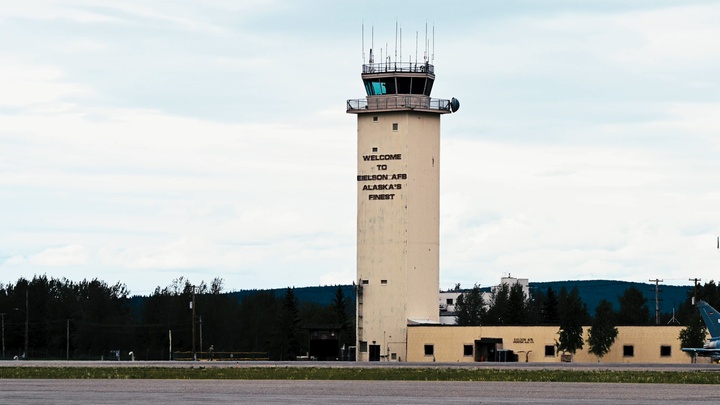

This marks the first year that Eielson has hosted the German air force and our other NATO partners for AD24.

“In short, Arctic Defender aims to push everyone's limits with a high-flying exercise involving complex scenarios,” said French Air Force Col. Eric, Arctic Defender French Detachment colonel and Pegase deputy commander. “We'll be developing and improving interoperability between nations. It's also a clear message to all: we're stronger together.”

Training with joint service members and allies during AD24 operations enhances our lethality and interoperability, enabling our forces to counter military aggression and coercion by sharing responsibilities for common defense.

“Joint exercises like this are important because they simulate real world operations, and this is how we're going to fight,” said U.S. Marine Corps Col. William Mitchell, Marine Aircraft Group 11 commanding officer. “The more we can train with our allies, partners and sister services, the better prepared we will be on the day of execution.”
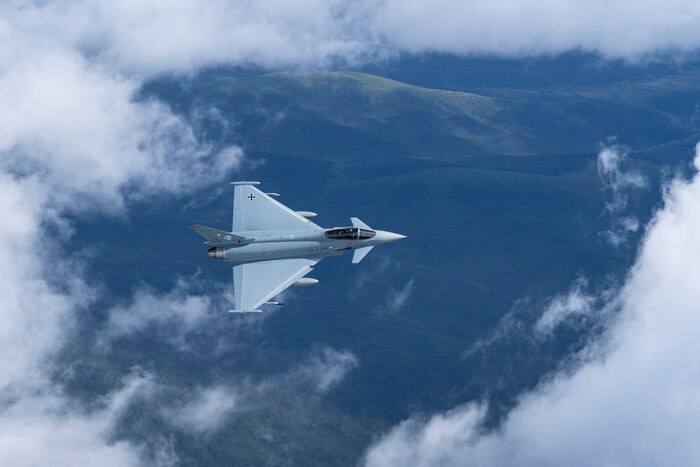
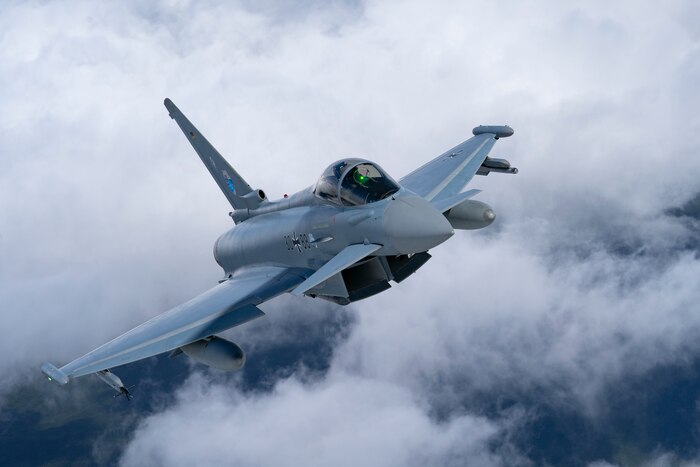
A German Air Force Eurofighter Typhoon flies over Alaska during exercise Arctic Defender 24 at Joint Base Elmendorf-Richardson, Alaska, July 8, 2024. Arctic Defender is a German Air Force-led exercise that provides a unique opportunity to integrate various forces into joint, coalition and multilateral training from simulated forward operating bases and is part of several exercises under Pacific Skies 24. Pacific Skies is a combination of several exercises in the Indo-Pacific theater in which German, French and Spanish air forces participate with U.S. forces. (U.S. Air Force photo Senior Airman Shelimar Rivera Rosado)
A French Air and Space Force avionic technician performs routine maintenance on a Rafale fighter jet during Arctic Defender 24 at Eielson Air Force Base, Alaska, July 9, 2024. AD24 is a component of Pacific Skies 24, a months-long deployment hosted by the German Air Force. Germany, France and Spain are partners in the trinational Future Combat Air System, and as the first stop in their deployment, AD24 is used to conduct realistic, total force combat training to maintain a free and open Indo-Pacific region through mission readiness and deterrence. (U.S. Air Force photo by Staff Sgt. Kelsea Caballero)


Airmen from Eielson AFB supported AD24 by sharing their knowledge of adversarial tactics, techniques and procedures with participating units. This ensures that the U.S. and its allies receive the best air combat training possible.

“I think it's a great opportunity to work with people doing different things and to get familiar with it,” said Spanish Air Force Capt. Jose Caamaño, 14th Wing fighter pilot. “We also have a wider range of weaponry here compared to Spain, so it's a great opportunity for tactical missions.”
Rockets are launched from a High Mobility Artillery Rocket System at the Donnelly Training Area outside of Fort Greely, Alaska, during exercise Arctic Defender July 15, 2024. Arctic Defender is a German Air Force-led exercise that provides a unique opportunity to integrate various forces into joint, coalition and multilateral training from simulated forward operating bases and is part of several exercises under Pacific Skies 24. Pacific Skies is a combination of several exercises in the Indo-Pacific theater in which German, French and Spanish air forces participate with U.S. forces. (U.S. Air Force photo by Staff Sgt. Derek Seifert)
Eielson AFB and Joint Base Elmendorf Richardson were chosen as the exercise locations due to the size of the Joint Pacific Alaska Range Complex, which spans more than 77,000 square miles, making it the largest combat training range in the world. Alaska also offers minimal air traffic, providing ample space for joint operations.

“We would like to thank the German, French, Canadian and Spanish air forces for making Arctic Defender 24 a success,” said U.S. Air Force Capt. Weston Umano, AD24 team chief. “The hard work and dedication of our allies is unmatched and the quality of training for AD24 followed suit. Events like this exercise showcase our combined joint interoperability; NATO is stronger together.”

By strengthening collaboration and coordination with our allies and partners in the Indo-Pacific through multilateral alliances, we can effectively address security challenges, enhance interoperability and foster international trust.


From left to right, a U.S. Air Force F-22 Raptor and F-16 Fighting Falcon, French Air and Space Force Dassault Rafale and Airbus A400M Atlas, a German Air Force Eurofighter Typhoon, a U.S. Marine Corps F/A-18 Hornet, a U.S. Air Force F-35A Lightning II, and a German Air Force PA-200 Tornado, fly in formation during Arctic Defender 24 at Joint Base Elmendorf-Richardson, Alaska, July 8, 2024. Arctic Defender is a German Air Force-led exercise that provides a unique opportunity to integrate various forces into joint, coalition and multilateral training from simulated forward operating bases and is part of several exercises under Pacific Skies 24. Pacific Skies is a combination of several exercises in the Indo-Pacific theater in which German, French and Spanish air forces participate with U.S. forces. (U.S. Air Force photo Senior Airman Julia Lebens)  A French Rafale fighter jet takes off from the runway during Arctic Defender 24 at Eielson Air Force Base, Alaska, July 8, 2024. International allies including France, Spain and Germany participate in multilateral combat training such as AD24 to enhance interoperability, build trust and evolve airpower. (U.S. Air Force photo by Staff Sgt. Kelsea Caballero)