Luke AFB concludes final US F-16 divestment
LUKE AIR FORCE BASE, Ariz. (AFNS) --
“The F-16 has been the backbone of the Air Force for over 50 years,” Ress said. “Fourth generation aircraft like the F-16 will continue to be the capacity, while fifth generation aircraft like the F-35 is now the capability.”
As a compact multi-role fighter, the F-16 has proven itself operational in both air-to-air combat and air-to-surface attack. The F-35 will continue this multi-capable legacy, but with added advanced sensors and data fusion allowing for unparalleled stealth and situational awareness.
“Inside the F-35 is technologies that were unimaginable when the F-16 was created,” Ress said. “The two are incomparable, and in 40 years there will be new generation aircraft that will continue to propel us forward as a warfighting force.”
Luke AFB began transitioning F-16 squadrons into F-35 squadrons in the early 2000s, the 309th being the last to transition out of the six fighter squadrons on base.
“This is one of the first times the 309th FS has been the last to anything,” said Dr. John Hale, 56th FW historian. “They were the first in combat in WWII and they were the first to navigate across the Pacific Ocean in 1952 using aerial refueling.”
The F-16 pilot training program began over 42 years ago in 1983 and has graduated over 20 thousand pilots since. The final class of F-16 student pilots graduated from the 309th FS in September 2024, and the last local training sortie was in February of 2025.
Luke AFB will continue to fly and train F-16 Republic of Singapore air force fighter pilots and maintainers from the 425th FS until they transition to Ebbing Air National Guard Base, Arkansas, in the coming years.
While the F-16’s chapter at Luke AFB comes to a close, its mission remains unchanged. Luke AFB will continue to train the world’s greatest fighter pilots and combat-ready Airmen, now with the unmatched capabilities of the F-35. This transition elevates the base’s lethality, strengthens the Air Force’s dominance and reinforces its deterrence and warfighting edge for the conflicts of today.
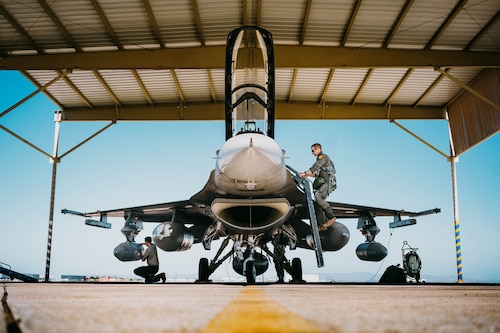
The 56th Fighter Wing flew the final F-16 Fighting Falcon flight out of Luke Air Force Base, March 24, delivering it to the 16th Weapons Squadron at Nellis AFB.
“The F-16 has been the backbone of the Air Force for over 50 years,” Ress said. “Fourth generation aircraft like the F-16 will continue to be the capacity, while fifth generation aircraft like the F-35 is now the capability.”
As a compact multi-role fighter, the F-16 has proven itself operational in both air-to-air combat and air-to-surface attack. The F-35 will continue this multi-capable legacy, but with added advanced sensors and data fusion allowing for unparalleled stealth and situational awareness.
“Inside the F-35 is technologies that were unimaginable when the F-16 was created,” Ress said. “The two are incomparable, and in 40 years there will be new generation aircraft that will continue to propel us forward as a warfighting force.”
Luke AFB began transitioning F-16 squadrons into F-35 squadrons in the early 2000s, the 309th being the last to transition out of the six fighter squadrons on base.

“This is one of the first times the 309th FS has been the last to anything,” said Dr. John Hale, 56th FW historian. “They were the first in combat in WWII and they were the first to navigate across the Pacific Ocean in 1952 using aerial refueling.”
The F-16 pilot training program began over 42 years ago in 1983 and has graduated over 20 thousand pilots since. The final class of F-16 student pilots graduated from the 309th FS in September 2024, and the last local training sortie was in February of 2025.
Luke AFB will continue to fly and train F-16 Republic of Singapore air force fighter pilots and maintainers from the 425th FS until they transition to Ebbing Air National Guard Base, Arkansas, in the coming years.
While the F-16’s chapter at Luke AFB comes to a close, its mission remains unchanged. Luke AFB will continue to train the world’s greatest fighter pilots and combat-ready Airmen, now with the unmatched capabilities of the F-35. This transition elevates the base’s lethality, strengthens the Air Force’s dominance and reinforces its deterrence and warfighting edge for the conflicts of today.
